A Day of Surprises
Once upon a time, a Lutheran pastor purchased a big leather book, and in that book began recording births, marriages and deaths of the people of Brezova pod Bradlom. The first entries in this book were recorded sometime after the Catholic clergy took over the Lutheran church building in 1729 and destroyed all earlier baptismal records. For 50 years the Lutherans met secretly in remote hillside settlements until the church was officially re-established in 1783. In 1843 a new page was turned in the big leather book, and the record of the family of my great-great grandparents, Jan and Alzbeta Rechtoris, was started. On that page, in that book, is entered the name of my grandmother, Judita, born on October 3, 1887.

The Lutheran pastor and our translator, Lubica, pore over the old church records.
On April 29, 2015 I sat in the office of the Evangelical Church of the Ausburg Confession in Brezova pod Bradlom, perhaps in the very room where a pastor recorded the name of my newborn grandmother in 1887. Rick and I watched with nervous anticipation as the current pastor turned pages looking for our family’s entry. Just as he seemed about to say “No, it is not here, I cannot find it,” suddenly an “Ahhh” and fingers pointing to an entry. It was a thrilling moment in an exciting day, a day that contained more than one surprise.

The current building of the Lutheran Church in Brezova pod Bradlom was built in 1873, only 14 years before my grandmother was born. The impressive building with its beautiful, neo-classical sanctuary was financed by local residents, which probably included some of my ancestors.
Brezova was a town of about 6,000 when my grandmother was born, and the Lutheran Church there had about 5,000 members, a size that today would be considered a mega church in any large city or suburb in the U.S. Around the time of my grandmother’s birth, it was the largest Lutheran Church in what is today Slovakia.
I don’t know how news of births, marriages and deaths spread or were accounted for, but standing before the church door, breathing the fresh, spring air of Brezova, it was easy for me to imagine a joyful young father standing on the very spot , knocking on that very door on a crisp fall day 128 years ago to announce: “Reverend, I have a new daughter. Her name is Judita.”
But perhaps the pastor was not greeted with joy, rather, appeals for fervent prayer. Before Judita and her older sister Alzbeta were born, my great-grandparents — Jan and Katerina — had twin boys, Jan and Juraj. Juraj lived 11 days and Jan lived 2 months, 3 weeks and 2 days. My great-grandfather himself was a twin — one of 12 children born to my great-great grandparents. Only four of these children lived to adulthood, and each of the five babies that preceded his birth lived for no more than a few months. Infant survival could not have been taken for granted by that father in that time.
An Archive of Mystery
We will never know the emotions that prevailed that day, or the prayers that were lifted to God. At some point, later that day or week or month, the pastor dipped his pen in ink and entered the name Judita just under the name Alzbeta in the big book. A few years later, the name Jan would once again be entered, but this Jan lived for only five days. Then, in 1892, Zuzana — who lived long enough to register in my childhood memories, a tiny little lady with white hair and a beaming smile. After Zuzana, Stefan, who survived only three weeks. We discovered the existence of Stefan 10 years ago when my sister uncovered his name while conducting geneological research. No death date was listed for Stefan in the records Jeanne found, and so until I made this trip, we wondered if it were possible we had not-too-distant cousins in Brezova. Viewing the church register solved that mystery.
But wait, there is more. A last child, Samuel, born September 14, 1896, died February 4, 1916. 19 years old at the time of death, the age of my youngest son. The only son. The only child who still lived in Brezova. I can’t imagine, don’t want to imagine.
This was a surprise. No one in the family, that I know of, ever heard that Grandma had a brother. He died during World War I, almost certainly fighting against the Germans as part of the movement to create an independent Czechoslovakia. (Remember, Brezova was part of the Austro-Hungarian Empire, so this would have made him a rebel fighter.) Milan Radislav Stefanik, perhaps the biggest hero in modern Slovak history, was born in the shadow of Brezova. His tombstone and a huge monument to him towers above the town of Brezova. During World War I, Stefanik organized and recruited soliders, and even traveled to Chicago to appeal to Slovak citizens there to come home to fight and/or contribute money to the cause. Samuel Rechtoris died in a hospital in Ukraine, which makes it likely he was connected with Stefanik’s Czecho-Slovak voluntary troops which allied with Russia, France and Great Britain against Germany and Austria-Hungary during World War I.
Why didn’t my grandmother ever mention her brother? Her sister Alzbeta had a son in Chicago, and he was named Sam. He was about the age of my mother, and I remember him. Was he named after this brother? Maybe. We may never know. It is tempting to speculate why this information was never shared, but if I try to do so I am afraid I will very quickly be over my head in the realms of psychology, history and political science.
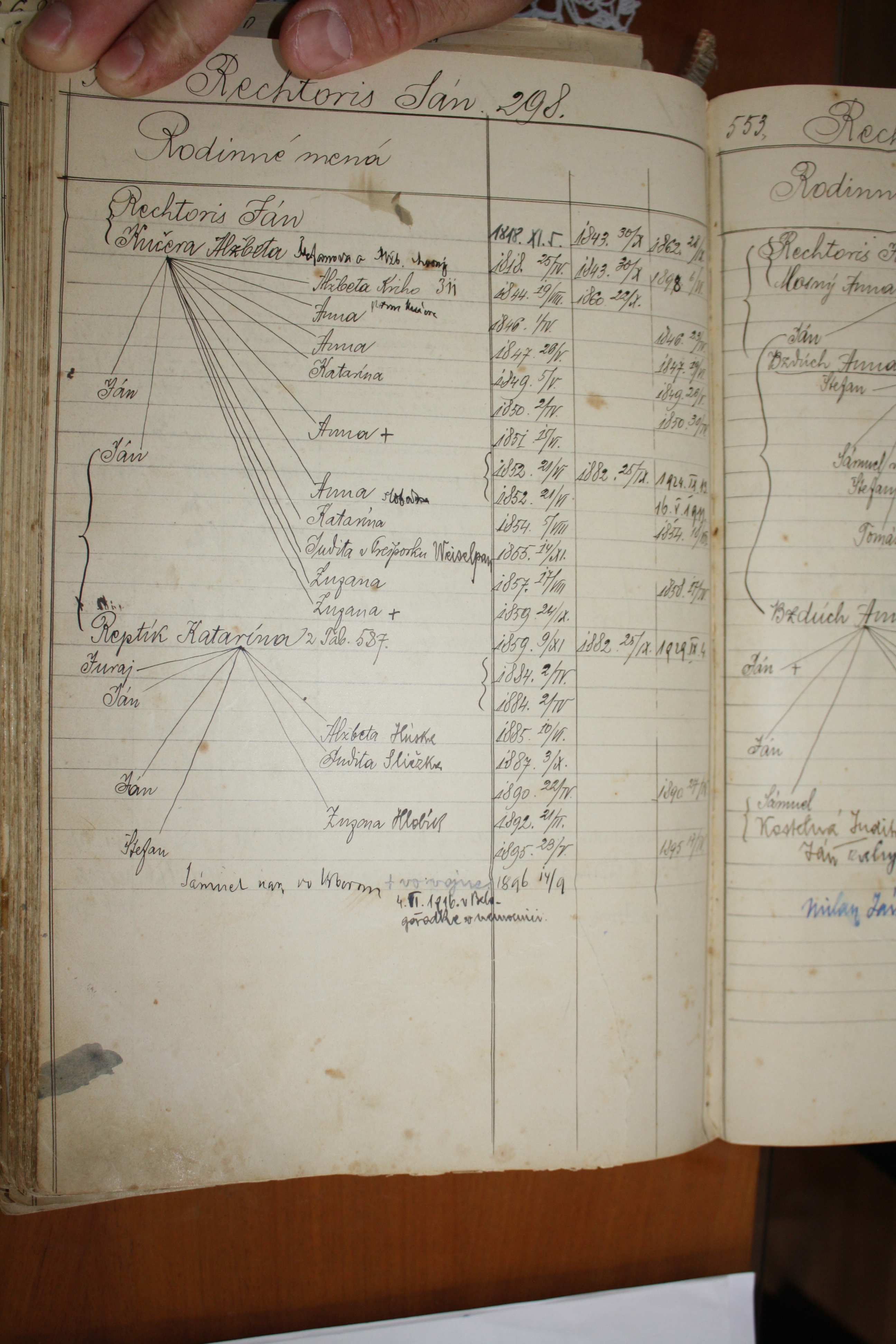
Records of the children of Jan and Katarina Rechtoris, the parents of my grandmother.
Finding out about this brother, Samuel, was a surprise, but not the only surprise of the day. I am quite certain that my grandmother could not have conceived a world in which her descendants could type her name on a keyboard and within minutes know all kinds of information she never intended to share. She probably never imagined her granddaughter – especially me, the youngest when she died — sitting in that church office in 2015, reading that church register. I hope she wouldn’t mind our snooping because it is motivated only by a desire to understand where we came from and how we came to be the people we are. I like to think she would understand and forgive our curiosity. Because there was, apparently, a secret to hide.
Next to each of Rechtoris daughters’ names in the big leather book was a surname. Next to Alzbeta, known to us as Aunt Lizzy, was the name Huska, which I know to be the name of her husband. Next to Zuzana, known to us as Aunt Susie, was the name Hlobuk, and next to Judita was a name that was not Schlegel! Was Grandma married before she left? It seems unlikely given that she is listed as Rechtoris on the ship’s manifest and given that she was only 18 when she arrived at Ellis Island. The Lutheran pastor explained that the name in the book, Sliazka, could have indicated engagement, not necessarily marriage. So, more mystery.
It is hard to understand why she did not tell her children about her brother Samuel, easier to imagine why this information may have been concealed. Was it a broken engagement, did a beloved die? Was he supposed to follow her to the U.S., and never found the means to go? Was she running away from an unwelcome match arranged by her parents? Or escaping an abusive relationship? My friend, Michele, also of Slovak descent, found in her own genealogical research instances of divorce in Slovakia at this time — and her relatives lived in a more remote village than mine.
I don’t need answers. In fact, this mystery unveiled truth for me. Wondering what happened helps me to see my grandmother as a young, vulnerable woman making perhaps the most difficult, wrenching decision of her life — not the strong matriarch memorialized by her children, not the strudel-making granny mythologized by us, her grandchildren. The unexpected finding in the church archives took me from the end of the story to the beginning, and that is an interesting place to be.
In my next post, I will write about my discoveries about how my ancestors earned their living, and how they lived.
 Naomi SIgler Hunter