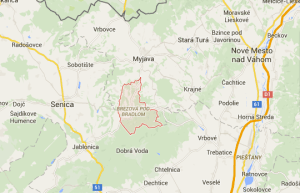
Map of Brezova. Click to zoom in or out.
Why did my grandmother leave Brezova pod Bradlom?
The story begins in 900 AD. Really? 900 AD? Well, that is where the local historian of the Myjava Region began when I posed the question to him.
“Please, I would like to give an overview of this region and then we will get to your questions about your grandmother,” the translator relayed to us. When the historian began with “Around 900 AD . . .” , I could tell that our translator was a bit concerned about how we would get through 1000 years of history in 30 minutes!
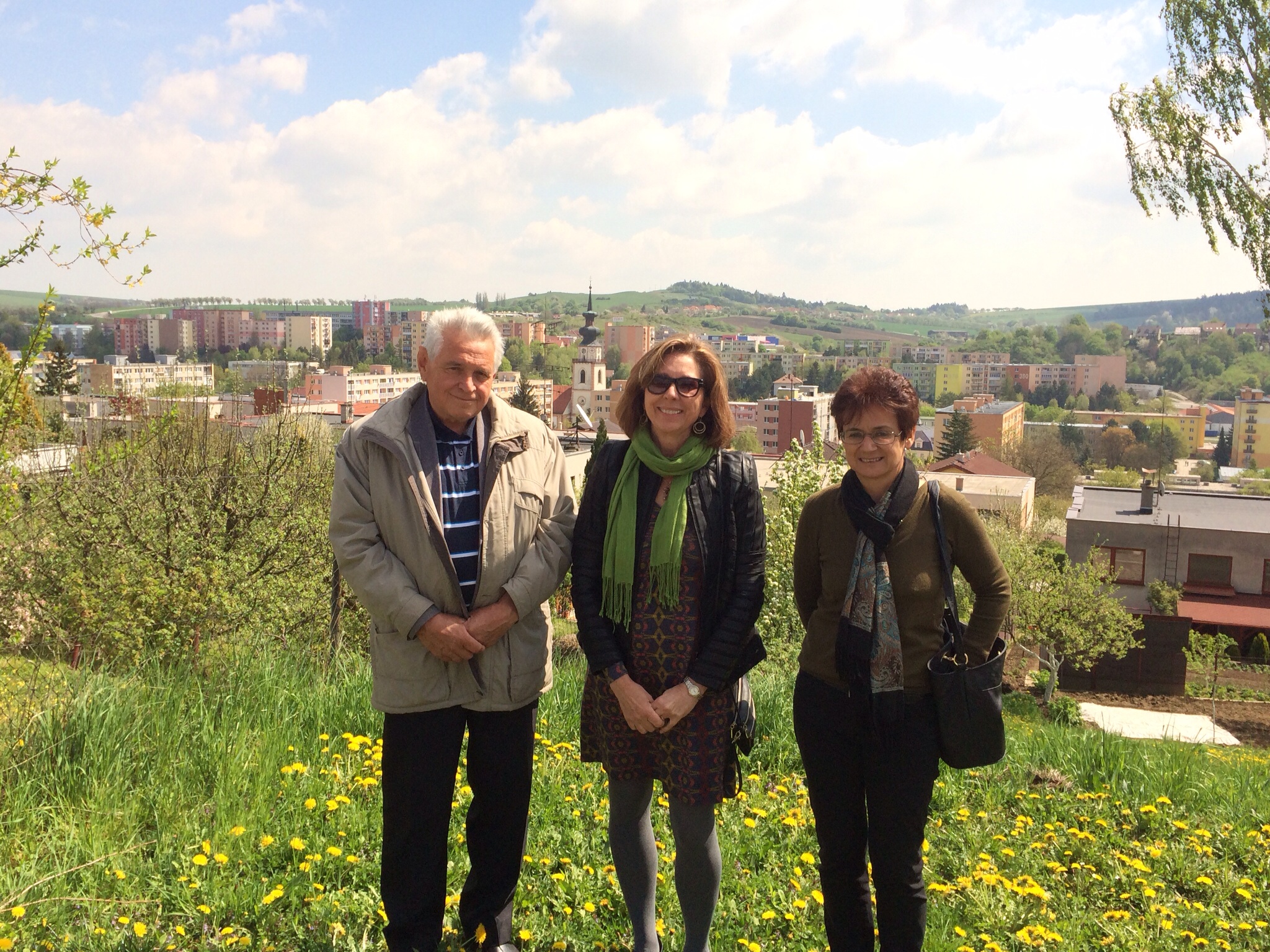
Local historian Jan Galik and our translator, Mrs. Lubica Ondrasikova of Luka Tours, s.r.o., with me above the town of Myjava.
Because very few people in the Myjava region speak English -which was forbidden during the Communist era – it was necessary for us to have an interpreter for the day. The hotel helped us find an English-speaking tour guide who drove us to Brezova from Bratislava and who also served as our translator. She was warm and wonderful, and quite got into the spirit of the exploration.
Way Leads on to Way
Before I go on, I should explain how it came about that Rick and I found ourselves in a meeting with Mr. Jan Galik, a Slovak-speaking regional historian at the Hotel Stefanik in Myjava, Slovakia, hearing a sweeping history of the land of my Rechtoris ancestors.
One of the things I did to prepare for our trip was look for some background materials on the history of Slovakia. The Schlegel grandchildren all grew up hearing that our grandmother came from Czechoslovakia, not too far from Vienna and the Austrian border. I had a vague understanding that she lived in an area of changing borders (which it turns out was not quite accurate), and thus could speak multiple languages. But we knew very little beyond this, and only discovered the name of her hometown a few years ago.
 About a month before our trip, I found a book called “My Slovakia, My Family” by John Palka, grandson of Milan Hodza, prime minister of Czechoslovakia during the turbulent years leading up to World War II. Mr. Palka’s book, published in 2012, is part memoir, part family history and part historical account of the Slovak people and the region of Central Europe that is modern day Slovakia. I have always most enjoyed learning history by hearing a story, and Mr. Palka’s is quite riveting. His family was exiled not once, but twice, from his homeland, and the first time was only a few weeks before his birth in 1939.
World Wars Become Personal
In all of my formal education about World War I and II, as well as what I have learned as an adult from reading, visiting museums and trying to understand current events, the politics of 20th century Europe had never been as clear to me as it was after reading Mr. Palka’s book. We often hear about how Neville Chamberlain appeased Hitler, for example, but I did not know (or perhaps did not comprehend) that the appeasement was a yielding of the Czechoslovakian border, a border not all that far from my grandmother’s hometown, and that was the beginning of World War II — a war in which my father and all five of Grandma Schlegel’s sons served.
When I finished the book, I did something I have never done before: I wrote an email to the author. I told him a very brief bit of my grandmother’s story, and thanked him for writing a book that helped me to understand the context of her decision to emigrate. Rick often quotes a line from Robert Frost’s The Road Not Taken: “way leads on to way” which turns out to be a quite apt description of how our adventure in Brezova began.
Mr. Palka answered immediately and warmly, and to my surprise, asked if I would be interested in meeting with Mr. Galik, who had been a resource on the Myjava region when he wrote his book. Rather awed at this possibility, I said, “Yes!” and our journey began.
Mr. Galik’s Sweeping Overview
So, yes, the story begins in 900 AD, which was close to the beginning of the Great Moravian Empire. Slavs first came to this region from Ukraine in the 5th century, and even earlier than that German tribes had settled in the area, but they didn’t stay permanently, The Danube was the border between Germanic tribes and Romans. A Roman inscription from the year 179 AD has been found in the area.
This Myjava region was part of the Great Moravian Empire from the mid 9th century to the early 10th century. The area of today’s Czech Republic and Slovakia are settled by three ethnically-related groups — the Bohemians, the Moravians and the Slovaks. In the middle of the 9th century Moravian Kings ruled the country . This was a very large empire that extended over today’s Bohemia (Czech Republic), Slovakia, southern Poland and western Hungary. It was a very important empire in the 9th century, and when it ended, it was the last time the people of this region would have self-rule for many centuries. And this is the beginning of the story that eventually caused many people to leave in search of an easier live, and why Mr. Galik began our family’s story with a history from so long ago.
As I listened, I began to understand that the story of Brezova and the Myjava region is a story of a people struggling for their religious and cultural identity, and their livelihood. Identity and economics were deeply connected, and the long history of hardship offers some hints as to why my grandmother left, and possibly why she never shared more of her background. Life was hard for centuries, both economically and politically, and I gather from what our driver told us, it still is.
(A bit of a disclaimer: The section below contains quite a bit of detailed history that is based on our notes from a translated oral history, so I want to be clear that errors or misunderstanding of the facts we heard are possible. I am sharing the story as I experienced it from listening to Mr. Galik on April 29, 2015. For those who are interested in reading official historical accounts, there are some written sources that my sister Jeanne found that we can share, and also there is some information available by googling Brezova pod Bradlom)
The Great Moravian Empire was conquered by the Hungarian kingdom, who ruled off and on until the end of World War I. (The actual history is much more complicated than that, of course, but for the purposes of our story, it suffices!) In the 13th Century, invaders from Turkey arrived in Hungary, which caused a wave of immigration north to the area of Myjava and Brezova. Only large stone fortresses could stop the Turkish invaders, so ten fortresses were built between the border of the Hungarian and Czech kingdom, including two in the Myjavan region. The construction of these castles was followed by a movement of people to the area.
The Ottoman Empire (Turkey) invaded Hungary again in mid 16th century, and this time the invasion was stronger and more successful and caused more people to flee from the south to the mountains around Brezova. This caused the founding of Brezova in 1555 and Myjava in 1558. This was a time of serfdom, so people needed permission of lords to move there. As the region grew in population, people built small settlements called Kopanista’s that consisted of 5-6 houses – something less than a village. Mr. Galik and our driver took us to the hills above Brezova and pointed out clusters of homes scattered around Brezova that are the modern day remnants of these Kopanistas. (These small settlements become part of our family story later . . .)
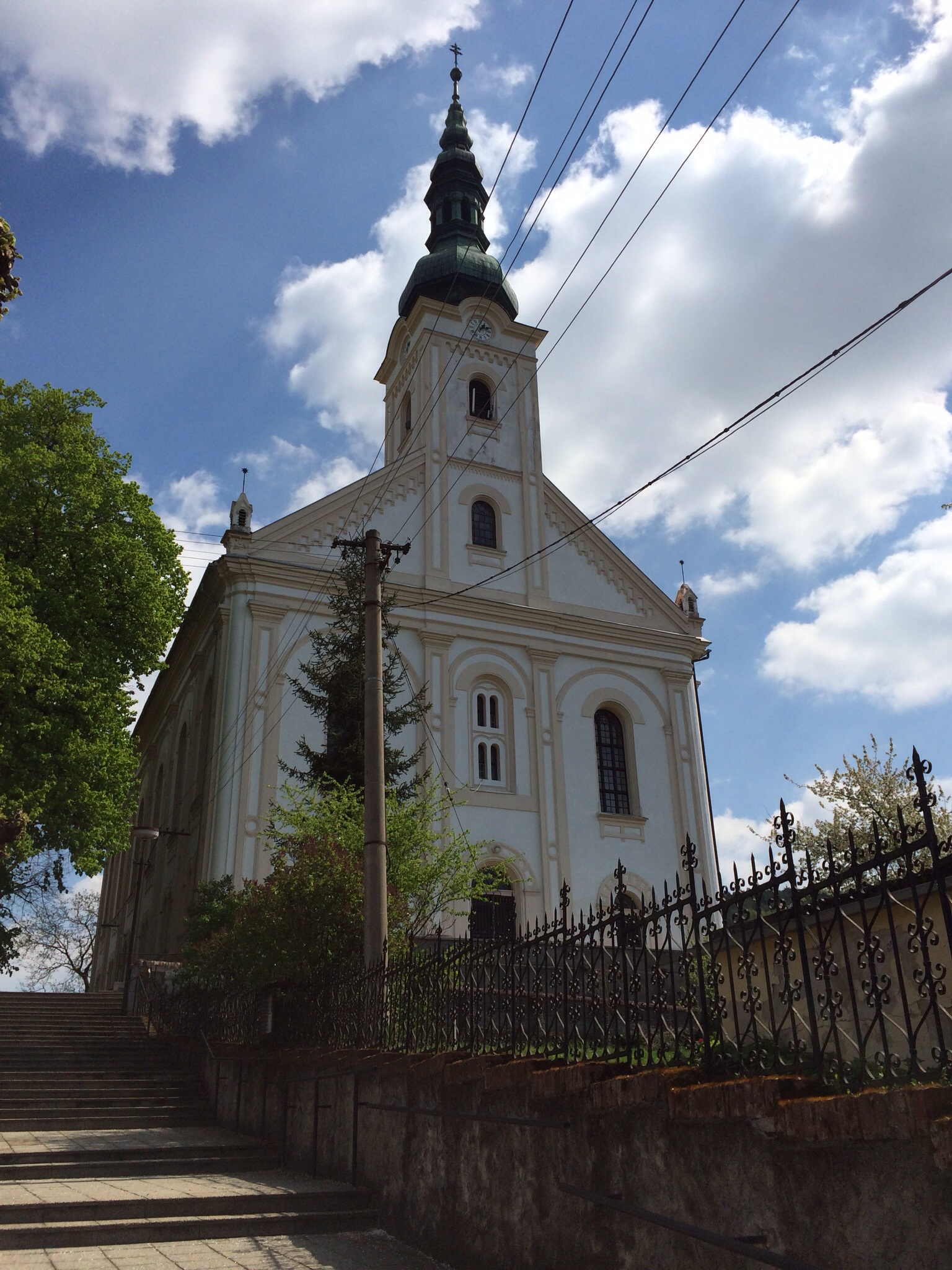
The Lutheran Church in Brezova where my grandmother was baptized. At the time this building was built, around 1870, it was the largest Lutheran church in Slovakia.
During the16th century there was another wave of immigration wave from north of Slovakia. The immigrants from the south had been farmers; these new immigrants from the north were shepherds from the mountains. To protect themselves, these shepherds used guns. They were a more militant people, and that becomes an important part of the story of this region. All who settled in the region were Lutherans, though Slovakia was a largely a Catholic nation under the rule of the Hapsburg Monarchy, who were staunch Catholics. The Lutheran identity is important in the history of Brezova, as it resulted in centuries of economic deprivation, which probably had at least an indirect effect on the later wave of immigration that included my grandmother.
Life was not easy for Lutherans in this region. Over the centuries they fought for religious freedom and later for their Slovak cultural identity. In the 17th century under the rule of the Habsburg Monarchy, there was re-Catholicization in the Austro-Hungarian Empire ( a reversal of the Reformation). Lutherans in the Brezova region were tough with weapons and they protected their right to practice their religion. But this part of country remained undeveloped compared with rest of country because it was a Lutheran region and unsupported by the Catholic Hapsburg Monarchy. Uprisings against the Habsburgs started in this region in the 17th century. The uprising was started by aristocrats and joined by citizens. The Habsburgs put down the the uprising and punished this region for participating.
In 1781 Maria Teresa (the Hapsburg queen) was replaced by her son Joseph II, who was influenced by the French Revolution, and gave equal rights to Catholics and Lutherans, and greater rights to Jews. So development finally started in this region at this time, but it was hard to overcome 200 years of no development.
Struggle for language identity
Joseph II wanted one official language in the region: German. But the Hungarian nobility was against this, since they were multicultural with Latin as the common language until late 18th century. The Hungarians pressured this region to have only the Hungarian language. (Struggle over language was a repeated theme in this area persisting to the time of my grandmother’s childhood, when the Slovak language was not allowed and people were made to speak Hungarian. I heard references to her multilinguism growing up, but I misunderstood it to be about changing borders. It was not that borders where changing (yet), but that the Hungarians sought for their language and culture to be dominant. Some sources I read say their goal was to wipe out the language and culture of the Moravians, Bohemians and the Slovaks.)
In 1848 a revolution against the Habsburg Empire came from many European nations. It was a time of great turmoil all over Europe. The center of the uprising in this part of the Hapsburg empire was Myjava, and it was led by Lutheran pastors. The uprising was suppressed, which caused more poverty, as trade crafts fell. This is the time when emigration to US first started. The Myjavan region, including Brezova, was a center of rebellion and movement for democratic rule. The local people suffered for this, as the region was often ignored as a punishment by those in power. Mr. Galik did not mention this, but another source I read suggested that a “heavy atmosphere” pervaded in Brezova for 70 years — from this time of uprising until the country of Czechoslovakia was formed in 1918. My grandmother was born in 1887, and left for America in 1905.
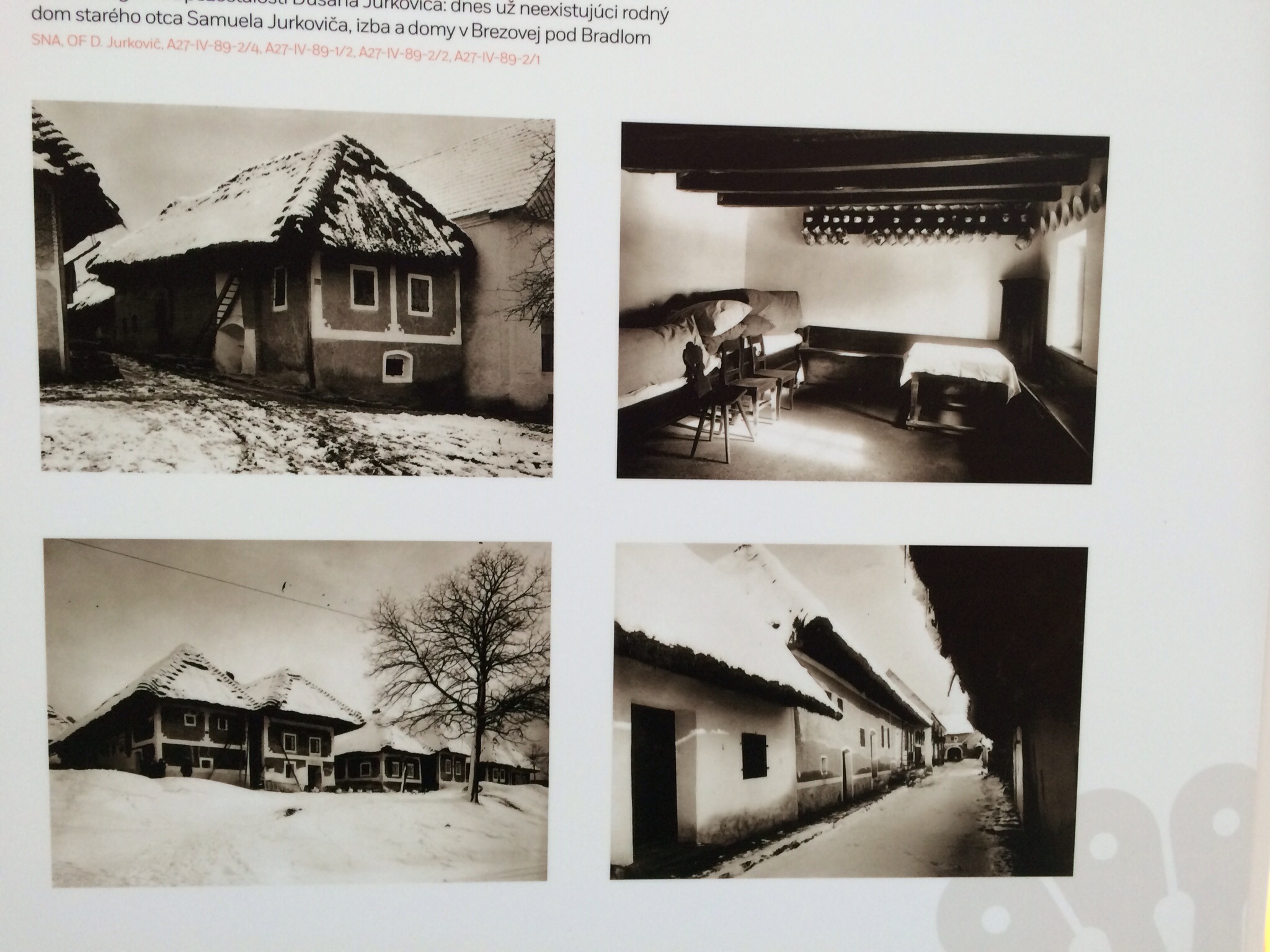
Typical homes of Brezova around the turn of the century. Very few of these historic homes still exist.
Emigrants from the Myjava region went mostly to the eastern part of US. Little Falls, NY, is known as Little Myjava. My grandmother and her sisters went to Chicago. I do not know why they ended up in Chicago, rather than New York. Perhaps my siblings or cousins know more about that. The number of citizens who left Brezova and the Majava region around the time my grandmother did was staggering: about 25% of the population between 1893 and 1908. Mr. Galik explained that nearly every household in the region today has relatives in the US.
At this point, Mr. Galik said, “And now we get to the reason your grandmother left. There was no industry at that time. Agriculture could feed only a certain number of people. There were no jobs, no work.” This is not really a surprise; many immigrants to the US came for economic opportunity, or as we like to say “to build a better life.” I suppose we all assumed this was the reason Grandma left. Yet, standing in the midst of the mountains she woke up to every morning, made it harder to take the momentous decision to leave for granted.
In the last seven years we have sent three 18-year-old sons off to college. Each time, I fought off tears knowing that for our sons it was a new beginning and would open doors of opportunity for them, even as it was closing a chapter for us. Each time, we knew we would see them in 10 weeks. My great grandparents said good-bye to three daughters and never saw them again. My 18-year-old grandmother had probably rarely, if ever, been more than a few miles from Brezova, yet off she went to the city of Chicago on the other side of the world. I can’t imagine.
In the next post, I will tell the adventure of my visit to the town, and share some of information about my ancestors I discovered from the town historian and the Lutheran pastor.
A Bit about Historian Jan Galik
Mr. Galik is a lifelong Myjava resident who has devoted his retirement to writing about the history of the region. He is probably about 70 years old. He told us that he spent his career overseeing the re-building of the the town of Myjava, and was responsible for most of the modern buildings and homes there. His uncle was a professor and began the historical work that he is now finishing. He has published two books on the region, but they are only available in Slovak, unfortunately!


What a wonderful story you have put together. I have really enjoyed reading it. I was only 10 or 11 when grandma died and never really heard mom talk about grandma’s past. Slovakia is on the bucket list of places to visit. Now I’m putting it to the top of the list. Thanks Naomi for this great blog.
LikeLike
Bonnie, when you go, I will be happy to share the information on the driver/translator we used, who was wonderful. That made all the difference in the quality of the experience we had!
LikeLike
I, too, am really enjoying this even though I have no family connections to the area (that I know of). I’m looking forward to the next installment!
LikeLike